
One of the strangest things a place can do is happily accept a reservation for one and then act like one person was a logistical surprise.
The reservation app had no problem with it. The host doesn’t blink. You are, by every technical definition, welcome.
Then you get the tiny table beside the service station. There is one empty chair directly across from you, just sitting there making a statement. Half the menu is “for the table.” The first course arrives quickly, the second arrives faster, and every pause has the vague energy of waiting for something else to happen.
Nothing is wrong.
Nothing is rude.
Nothing is particularly enjoyable either.
That is the difference between a place you can go alone and a place that is actually good solo.
This is not mainly a question of whether anyone will judge you for showing up by yourself. Most of the time, nobody cares nearly as much as the internet has led us to believe.
The more useful question is whether the place produces a good experience for one person.
For SOS, a place is good solo when its physical setup, pacing, atmosphere, activity, and logistics still create a satisfying, complete experience with one person in it. You do not need company to supply the entertainment, structure, energy, or reason for being there.
Good solo is not permission.
It is fit.
Hospitality researchers have a term for the physical surroundings that shape a service experience: the servicescape. A 2025 meta-analysis found that the service environment does affect consumer satisfaction, although which elements matter most depends on the setting and what the customer is there to do.[1]
Which is a very research-paper way of confirming something you already know: the room matters.
So does what the room asks of you.
Good solo gives your attention somewhere to land
Conversation does a lot of invisible work in a group outing.
It fills the wait for the food. It gives you something to do between songs. It smooths over the ten quiet minutes before a show starts. It can make a fairly ordinary room feel lively because, well, you brought the lively part with you.
When you are by yourself, the place has to carry a little more of its own weight.
That does not mean a solo-friendly place needs constant stimulation. It means there is something natural for your attention to rest on besides your phone.
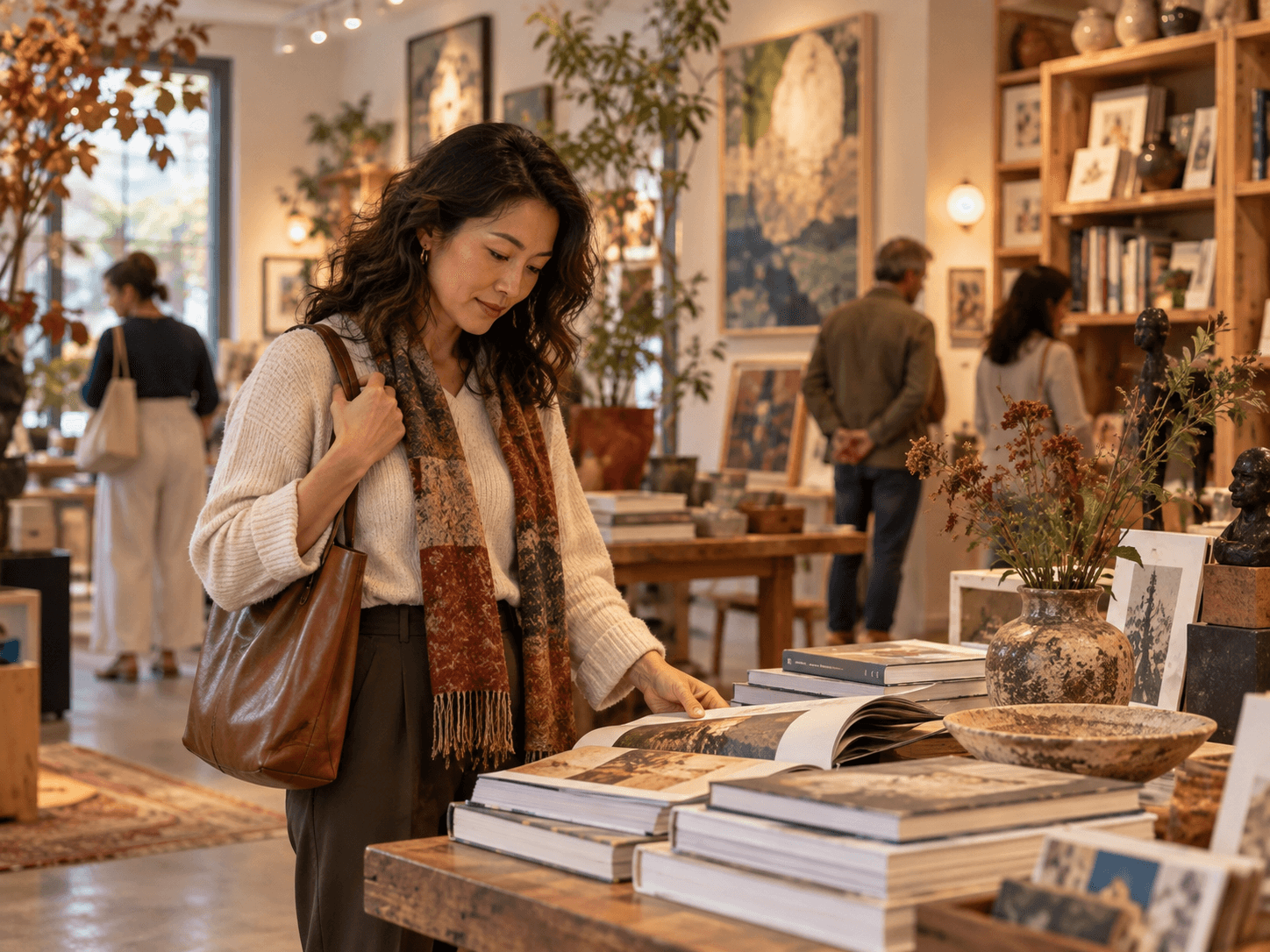
A window overlooking the street. An open kitchen. Art on the walls that rewards a closer look. A bar where you can watch drinks being made. A garden path that keeps unfolding. A bookstore with actual browsing room. A market with enough movement to wander without needing a plan.
The best solo places often have built-in activity or visual interest. Something is happening, but you do not have to make it happen.
That is why a museum can work beautifully with one person while a gorgeous restaurant with a blank wall, long gaps between courses, and nothing else to engage with can feel weirdly flat.
It is not because dining alone is inherently awkward.
The museum simply knows what to do with your attention.
The space should know what to do with one person
There is a difference between having a seat available and having a seat that makes sense.
A good solo seat feels intentional.
It might be a small table along a wall. A counter with a view of the room. A banquette where one person does not look like she has been abandoned halfway through a meeting. A café chair close enough to the action that you feel part of the place without sitting directly in the traffic pattern between the register and the bathroom.
A U.S. study of solo diners found that food, service, and the physical restaurant environment were all positively related to satisfaction.[2] Another hospitality study found that physical and psychological boundaries in restaurants were associated with a stronger sense of personal territory for solo diners, which was then associated with satisfaction and revisit intentions.[3]
You do not have to use the phrase “perceived territoriality” the next time you ask for a better table.
But the idea is useful.
People tend to enjoy a space more when they can settle into it and feel, for a little while, that this is their spot.
That does not require hiding in a corner. It is not about making one person invisible.
It is about enough definition and control that you feel placed, not parked.
You should be able to choose your own pace
One of the pleasures of going somewhere by yourself is that the outing can move at your speed.
You can spend 40 minutes in one gallery and seven in the next.
You can order another drink because you are not ready to leave.
You can eat lunch, realize the weather is too nice to go home yet, and take the long way back.
Or you can be finished in an hour and call it a perfectly good outing.
A place works well solo when the experience can flex without feeling broken.
Sometimes the flexibility comes from the format. Museums, markets, gardens, bookstores, hotel lounges, neighborhood walks, and many casual restaurants naturally let you arrive, settle in, and decide how long you want to stay.
Sometimes the experience is more structured. A class, performance, tasting, or tour has a set rhythm, but that can work solo too because the structure is built into the thing itself. You are not responsible for creating momentum.
The problem is the in-between place that gives you neither freedom nor structure.
You are rushed when you want to linger. Left hanging when you want something to happen. Seated for a long experience that has no real rhythm unless another person is there to fill it.
Good solo has a tempo.
And ideally, you get some say in it.
A little life goes a long way
A place does not have to be quiet to be good solo.
In fact, complete emptiness can make an otherwise nice space feel oddly unfinished. Sometimes what you want is a room with a pulse.
People talking two tables over. Someone ordering at the bar. A server moving through the room. Music low enough to notice but not compete with your thoughts. Enough motion to make you feel like you have gone somewhere.
You can enjoy the energy without needing to participate in it.
A 2026 mixed-methods study of public open spaces in Hong Kong found that solitary experiences were shaped partly by physical features such as seating, visual seclusion, and access, but also by the broader social and environmental setting.[4] It is one specific urban context, not a universal blueprint. The useful part for SOS is simpler: being alone in public is not just about the person. The environment helps create the experience.
Good solo often sits in that middle ground.
Not isolated.
Not socially demanding.
Just alive enough that the place brings some energy of its own.
Friction counts as part of the outing
A beautiful place can still be a mediocre solo outing if getting into it feels like an escape room.
The parking instructions are buried three clicks deep.
The entrance is on a completely different street from the address.
You have to download an app to order, create an account to park, scan a code to find the menu, and somehow already know that “rear entrance” means the unmarked gray door beside the loading dock.
By the time you sit down, the outing has already spent more of your attention than it has earned.
This matters for everyone. It can matter even more when you are alone because there is no second person quietly handling half the admin.
Nobody else is checking the confirmation email while you drive.
Nobody is standing in line while you find the parking kiosk.
Nobody is holding the table while you go ask whether you were supposed to check in somewhere else.
You are the guest and the logistics department.
Good solo does not mean zero friction. A hidden entrance can be part of the fun when the hidden entrance is the point.
It means the work required to access the experience feels proportionate to the experience itself.
The place should not make you earn the right to relax there.
The experience should still feel complete
This may be the clearest test of all.
If you remove the companion, what is left?
Some places are excellent for groups because the company is doing a major share of the work. The venue provides the table, drinks, maybe a nice backdrop, and the people you came with provide the actual occasion.
There is nothing wrong with that.
But it is different from a place that still has plenty to offer when there is only one of you.
A good solo outing has content.
There is something to taste, notice, learn, watch, make, hear, browse, explore, or simply enjoy.
The experience does not shrink down to “sit here until you are ready to leave.”
And sometimes it gets better.
You can read every placard you care about and skip the ones you do not. Take the window seat without negotiating. Order the thing nobody else likes. Change your mind halfway through. Stay longer. Leave earlier. Follow your own curiosity without turning it into a committee meeting.
That does not make solo objectively better.
It means autonomy is part of what the place can offer.
The experience still works at full strength with one person in it.
Good solo is a fit, not a permanent label
A venue does not earn a little gold “solo-friendly” sticker forever.
The same place can be wonderful alone at one time and deeply mediocre at another.
A restaurant bar at 5:30 may be relaxed, easy, and interesting. At 8:30 on Saturday, the exact same seat may be buried three people deep behind a birthday crowd.
A café can be a lovely place to linger on a weekday afternoon and complete chaos during weekend brunch.
A gallery can feel spacious one day and like human Tetris during a special event.
So “good solo” is not a fixed personality trait of a venue.
It is a fit between the place, the format, the time, and the experience you want from it.
That is also why generic “things to do” lists stop a little too early.
They tell you what exists.
They might tell you what is popular, pretty, highly rated, new, expensive, cheap, nearby, or open right now.
They do not necessarily tell you what the place is like when there is one of you.
A place can welcome one person without being particularly good at having one person.
The reservation form can accept “1.”
The better question is whether the experience knows what to do with her once she arrives.
Sources
[1] 2025 Psychology & Marketing meta-analysis on servicescape dimensions and consumer satisfaction: Source
[2] U.S. survey study of solo diners on food quality, service quality, the physical environment, and satisfaction: Source
[3] 2020 hospitality study on restaurant boundaries, perceived territoriality, satisfaction, and revisit intentions among solo diners: Source
[4] 2026 mixed-methods study of public open spaces in Hong Kong examining environmental features and solitary practices: PubMed